
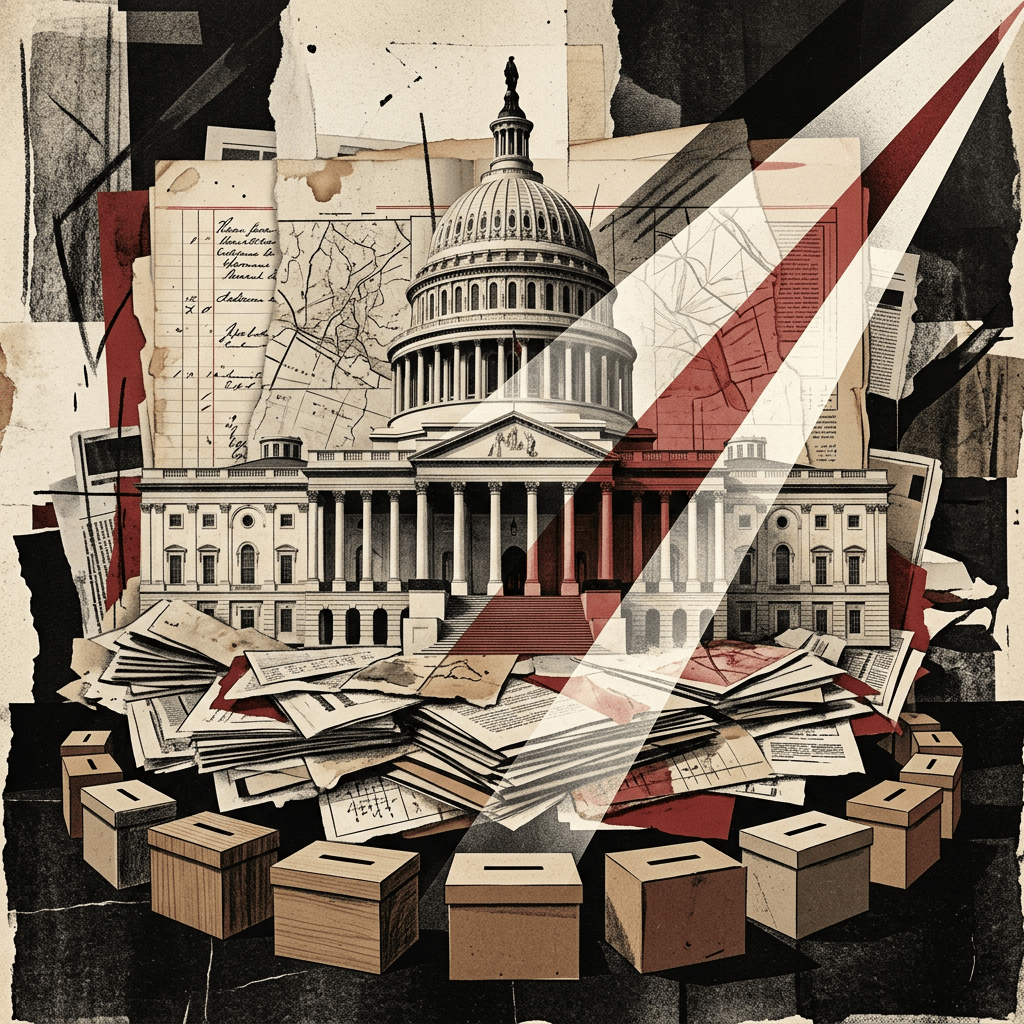
Congressional Silence, Executive Power, and Constitutional Accountability
War Powers, Civilian Protection, Institutional Oversight, and the Responsibilities of American Voters
Legal research and public-policy analysis | October 2026
Research status: doctrinal analysis grounded in identified primary authorities. Specific 2025–2026 incidents and officials’ current voting records require source verification before this paper can be presented as an investigative finding.
Abstract
This paper evaluates the legal distinction between executive military authority and congressional oversight; the rules governing lethal force and civilian protection; and the political significance of congressional speech, silence, and legislative conduct. It advances a narrow thesis: although silence alone ordinarily does not establish criminal complicity or an actionable constitutional violation, Congress’s failure to employ available oversight mechanisms when credible allegations of unlawful conduct arise can weaken constitutional checks and democratic accountability. It proposes an evidence-based, nonpartisan method for voters to assess representatives without presuming culpability from party membership or the absence of public comment.
I. Research question, method, and limits
The principal question is: how should voters evaluate Congress’s exercise—or nonexercise—of oversight when the executive conducts controversial military or security operations? The analysis distinguishes four levels: (1) a documented event; (2) a plausible legal issue; (3) a substantiated legal violation; and (4) responsibility of a particular individual. These levels should not be collapsed. [1]
This is a doctrinal and institutional paper, not a completed fact-finding investigation. It draws on constitutional text, federal statutes, judicial decisions, international instruments, and publicly accessible oversight records. Reports of maritime strikes near Venezuela, an attack on a school in Iran, and U.S. assistance to Israeli operations in Gaza are treated as research subjects, not independently established findings of who targeted whom, the casualty counts, or criminal intent. Any final incident-specific conclusion requires dated, corroborated reporting and, where available, official documents and independent investigations.
II. The constitutional allocation of military power
Article I assigns Congress powers to declare war, raise and support armed forces, regulate them, and appropriate funds. Article II makes the president commander-in-chief. The resulting distribution creates overlapping, contested authority rather than a simple rule that every overseas use of force must first receive a formal declaration of war. [2]
The War Powers Resolution requires consultation in specified circumstances, reporting within 48 hours when forces are introduced into hostilities or certain other situations, and generally termination within 60 days absent congressional authorization, with a limited withdrawal period. The statute’s interpretation and constitutionality have long been contested. A legal assessment of any particular operation must identify the asserted statutory or constitutional basis, the nature of hostilities, reporting, congressional action, and relevant timing. [3]
Youngstown teaches that presidential power must be assessed against congressional authorization or opposition. It is not a universal answer to the legality of any specific strike, but it provides a central separation-of-powers framework. [4]
III. Limits on lethal force and protection of civilians
The law applicable to a maritime strike depends on the facts: location, sovereign consent, the nature of the operation, and whether an armed conflict exists. The United Nations Charter generally prohibits force against another state, subject to recognized exceptions such as self-defense and Security Council authorization. Territorial waters and the high seas also raise different jurisdictional questions. [5]
Outside an armed conflict, applicable human-rights standards, necessity, and proportionality constrain the use of potentially lethal law-enforcement force. Suspicion of narcotics trafficking alone does not automatically transform civilians into lawful military targets. Within an armed conflict, international humanitarian law requires distinction, proportionality, and feasible precautions; intentionally directing attacks against civilians can constitute a war crime when the relevant legal elements are satisfied. [6]
Schools and homes are ordinarily civilian objects. Their destruction or the deaths of children warrant rigorous inquiry, but civilian casualties alone do not conclusively establish a war crime; investigators must examine the target’s status, intelligence available at the time, expected incidental harm, military advantage, precautions, and intent. The same evidentiary discipline applies to reports of attacks involving Iranian schools and civilian areas in Gaza. [7]
IV. U.S. assistance to foreign military operations
U.S. military assistance to another government raises questions distinct from direct U.S. targeting. Investigators must identify the assistance provided, applicable U.S. arms-transfer restrictions, the recipient’s conduct, relevant officials’ knowledge and purpose, and any governing international responsibility standards. U.S. foreign assistance law and the Arms Export Control Act provide important statutory starting points; neither support for an ally nor the existence of civilian harm alone establishes U.S. officials’ personal criminal liability. [8]
An analytically sound study should examine humanitarian impacts, individual attacks, the legal rules governing weapons transfers, and Congress’s legislative and appropriations responses separately. Assertions that a particular U.S. official committed a war crime require proof of the offense’s elements and an available forum with jurisdiction.
V. What congressional oversight entails—and does not entail
Congress can hold hearings, request documents, issue subpoenas through authorized procedures, condition or withhold appropriations, enact restrictions, seek reporting, and consider impeachment. The House has the sole power of impeachment and the Senate the sole power to try impeachments. Oversight is a core institutional practice, though individual legislators do not possess an unrestricted personal power to compel executive compliance. [9]
Not every failure to issue a public condemnation amounts to legal wrongdoing. Oversight may occur through classified briefings, correspondence, committee work, or votes; legislative discretion and constitutional protections for legislative acts also matter. The Speech or Debate Clause protects legitimate legislative activity and complicates attempts to convert political disagreements over legislative conduct into personal liability. [10]
Nonetheless, a representative’s consistent refusal to explain the legal basis for contested force, seek evidence, or address credible civilian-harm allegations can be criticized as a failure of public accountability. Such an evaluation should be expressly political or ethical unless a specific legal duty and its breach are established.
VI. Silence, complicity, and the threshold for liability
The term “complicity” has at least three meanings: ordinary-language acquiescence, political or ethical responsibility, and legal participation in wrongful conduct. They are not interchangeable. Silence may have powerful political meaning, but criminal aiding-and-abetting liability generally requires more than a legislator’s failure to speak. [11]
War-crimes responsibility likewise depends on an applicable offense, jurisdiction, and the person’s conduct and mental state. Command responsibility involves specialized requirements and cannot be presumed merely from holding senior office. Article III narrowly defines treason and does not use it as a generic label for unconstitutional or immoral governmental conduct. [12]
The research therefore evaluates lawmakers using a graduated scale: documented support, documented opposition, active oversight, passive oversight, no publicly identified action, and insufficient evidence. “No publicly identified action” must never be rewritten as “did nothing” without searching nonpublicly visible avenues of oversight as far as practicable.
VII. A voter-facing accountability methodology
For each incumbent, researchers should establish a timeline of the contested executive action and then examine: (a) public statements, with dates and exact quotations; (b) recorded votes and sponsored bills; (c) hearings attended and questions asked; (d) signed oversight letters or requests for records; (e) appropriations and authorization decisions; and (f) responses to constituents. Each entry should carry a source URL, date, and a confidence rating. [13]
Challengers should be evaluated by the same constitutional standards, with one distinction: they cannot be scored for congressional votes they never had the opportunity to cast. Their evidence instead includes prior public service, policy commitments, legal reasoning, financial disclosures, and willingness to articulate a position even when politically inconvenient.
For Indiana’s Second Congressional District, a completed application would evaluate Representative Rudy Yakym’s verified roll-call votes and committee record alongside his challengers’ published commitments. No finding of silence, complicity, or legal misconduct is made here because the requisite incident-by-incident record has not been assembled. The same methodology can be applied nationally without a party-based presumption.
VIII. Counterarguments and institutional constraints
Defenders of executive discretion argue that urgent threats may require rapid action, that some intelligence cannot safely be disclosed, and that classified oversight can be more useful than public denunciation. Those are serious considerations, but they do not erase requirements of lawful authority, necessity, appropriate targeting, or accountability after the fact.
Another objection is that public silence may reflect incomplete information rather than agreement. This is why the paper rejects a simplistic silence-equals-crime theory. Conversely, classified briefings cannot become a blanket substitute for meaningful public explanation, especially where civilian deaths and the use of American force are at issue.
IX. Findings and conclusion
First, executive military power is constitutionally constrained, though the necessity of prior congressional authorization depends on the operation and the contested interaction of Article I, Article II, and governing statutes. Second, suspected criminality does not alone establish lawful military target status. Third, civilian-harm allegations require credible, independent, incident-specific investigation. Fourth, congressional silence is not itself proof of legal complicity, but failure to exercise oversight can have grave institutional and democratic consequences.
For voters, the defensible standard is neither automatic support for an incumbent nor automatic guilt by party association. It is documented conduct: what an official knew, said, requested, investigated, authorized, opposed, and explained. Public office entails a duty to the constitutional system and to constituents. Elections are an appropriate occasion to demand a transparent accounting of that duty.
Legal footnotes and authorities
1. See U.S. Const. arts. I–III; compare political accountability with criminal liability under 18 U.S.C. § 2.
2. U.S. Const. art. I, § 8, cls. 11–16; id. art. II, § 2, cl. 1.
3. War Powers Resolution, Pub. L. No. 93-148, 87 Stat. 555 (1973) (codified at 50 U.S.C. §§ 1541–1548), especially §§ 1542–1544.
4. Youngstown Sheet & Tube Co. v. Sawyer, 343 U.S. 579, 635–38 (1952) (Jackson, J., concurring).
5. U.N. Charter arts. 2(4), 39–42, 51; United Nations Convention on the Law of the Sea arts. 2–3, 87, 92 (maritime framework; the United States is not a party to UNCLOS).
6. U.N. Basic Principles on the Use of Force and Firearms by Law Enforcement Officials, principles 4, 5, 9 (1990); Protocol Additional I to the Geneva Conventions arts. 48, 51, 52, 57 (1977) (many core rules also reflected in customary law; the United States has not ratified Protocol I).
7. Rome Statute of the International Criminal Court art. 8(2)(b)(i)–(ii), (iv), (ix) (1998) (describes international criminal-law categories; U.S. is not a State Party); ICRC, Customary International Humanitarian Law Study, Rules 1, 7, 14–15.
8. Arms Export Control Act, 22 U.S.C. §§ 2751 et seq.; Foreign Assistance Act of 1961, 22 U.S.C. §§ 2151 et seq., including § 2304.
9. U.S. Const. art. I, §§ 2–3, 8–9; McGrain v. Daugherty, 273 U.S. 135, 174–75 (1927) (congressional investigatory power).
10. U.S. Const. art. I, § 6, cl. 1; Eastland v. U.S. Servicemen’s Fund, 421 U.S. 491, 501–03 (1975).
11. 18 U.S.C. § 2 (aiding and abetting); Rosemond v. United States, 572 U.S. 65, 71–78 (2014) (elements in the context of the offense at issue).
12. U.S. Const. art. III, § 3 (treason); 18 U.S.C. § 2441 (War Crimes Act); Rome Statute art. 28 (command responsibility; not a statement of U.S. domestic jurisdiction).
13. U.S. House Clerk, Roll Call Votes, https://clerk.house.gov/Votes; Congress.gov, https://www.congress.gov/; Congressional Record, https://www.congress.gov/congressional-record; House Committee Repository, https://docs.house.gov/.
Bibliography and research repositories
United States Constitution. National Archives. https://www.archives.gov/founding-docs/constitution-transcript
War Powers Resolution, 50 U.S.C. §§ 1541–1548. U.S. House Office of the Law Revision Counsel. https://uscode.house.gov/
18 U.S.C. §§ 2, 2441; 22 U.S.C. §§ 2304, 2751 et seq. U.S. Code. https://uscode.house.gov/
Youngstown Sheet & Tube Co. v. Sawyer, 343 U.S. 579 (1952). https://supreme.justia.com/cases/federal/us/343/579/
McGrain v. Daugherty, 273 U.S. 135 (1927). https://supreme.justia.com/cases/federal/us/273/135/
Eastland v. U.S. Servicemen’s Fund, 421 U.S. 491 (1975). https://supreme.justia.com/cases/federal/us/421/491/
Rosemond v. United States, 572 U.S. 65 (2014). https://supreme.justia.com/cases/federal/us/572/65/
United Nations Charter. https://www.un.org/en/about-us/un-charter/full-text
International Committee of the Red Cross. Customary IHL Database. https://ihl-databases.icrc.org/en/customary-ihl
United Nations Human Rights Office. Basic Principles on the Use of Force and Firearms by Law Enforcement Officials. https://www.ohchr.org/en/instruments-mechanisms/instruments/basic-principles-use-force-and-firearms-law-enforcement
Congress.gov. Legislative histories, member profiles, and Congressional Record. https://www.congress.gov/
Clerk of the U.S. House of Representatives. Roll Call Votes. https://clerk.house.gov/Votes
U.S. Government Accountability Office. Reports and legal decisions. https://www.gao.gov/
U.S. Department of Defense. Official statements and releases. https://www.defense.gov/
United Nations Office for the Coordination of Humanitarian Affairs. Humanitarian reporting. https://www.unocha.org/
College draft research paper:
GMD


Leave a Reply