Executive Power, Congressional Failure, and Democratic Risk in the Trump Administration
Introduction
The United States Constitution establishes a system of separated powers designed to prevent the concentration of authority in any single branch of government. Congress, as the legislative branch, was intended to be the dominant institution, responsible for declaring war, controlling public spending, conducting oversight, and restraining executive abuse (U.S. Const. art. I, § 8). The Trump administration exposed how fragile that design becomes when Congress fails to exercise its authority.
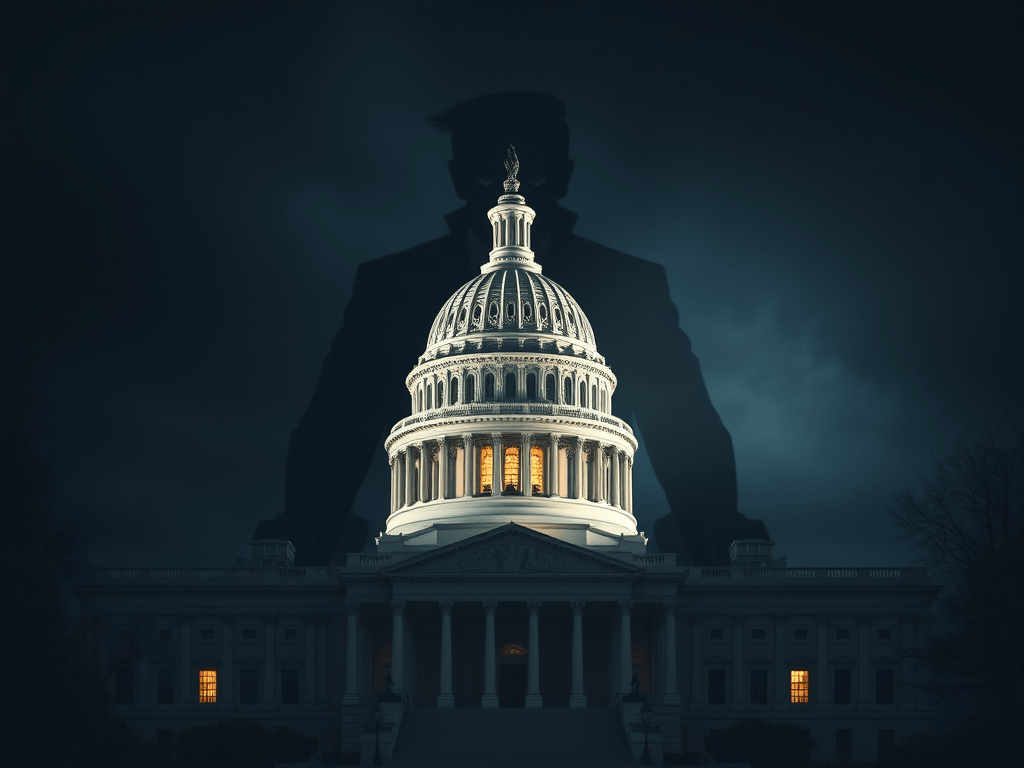
The central danger of the Trump era was not merely controversial policy or inflammatory rhetoric, but the combination of aggressive executive behavior and congressional incapacity. Together, these forces weakened democratic accountability and normalized unchecked presidential power, revealing systemic vulnerabilities that extend beyond any single administration.
Congressional Weakness and the Erosion of Article I Authority
Article I of the Constitution grants Congress the power to legislate, appropriate funds, regulate foreign commerce, and declare war (U.S. Const. art. I, § 8). These powers are not symbolic; they are foundational to democratic governance. Yet over time, Congress has increasingly delegated broad authority to the executive branch through vague statutes, emergency powers, and expansive national security authorizations.
The War Powers Resolution of 1973 was enacted to restrain unilateral presidential military action by requiring congressional authorization within sixty days (50 U.S.C. §§ 1541–1548). In practice, presidents of both parties—including Donald Trump—have treated the statute as a notification requirement rather than a binding limitation. Congress has rarely enforced the law’s withdrawal provisions, rendering it largely symbolic (Congressional Research Service [CRS], 2022).
This pattern reflects a broader institutional failure in which partisan loyalty and electoral incentives override Congress’s constitutional responsibility to function as a co-equal branch. When Congress declines to exercise its authority, that authority does not disappear; it migrates to the executive.
Executive Action, Military Force, and Constitutional Limits
Although the president serves as Commander in Chief of the armed forces (U.S. Const. art. II, § 2), the Constitution does not grant unilateral war-making authority. Nevertheless, modern presidents have increasingly relied on outdated Authorizations for Use of Military Force (AUMFs) to justify military operations far removed from their original congressional intent.
The 2001 Authorization for Use of Military Force has been used to support military actions across multiple regions and conflicts unrelated to the September 11 attacks that prompted its passage (Authorization for Use of Military Force, 2001). Congress’s failure to repeal, narrow, or replace this authorization has enabled executive discretion to expand unchecked, increasing the risk of escalation, miscalculation, and democratic deficit (CRS, 2022).
When decisions of war and peace hinge on executive discretion alone, national security depends on personal restraint rather than constitutional enforcement. History demonstrates that republics do not endure under such conditions.
Ethics, Self-Enrichment, and the Emoluments Problem
The Trump administration raised unprecedented ethical concerns due to the president’s continued ownership of private business interests while in office. The Constitution’s Foreign and Domestic Emoluments Clauses prohibit federal officials from accepting benefits from foreign governments without congressional consent and from receiving additional domestic compensation beyond their official salary (U.S. Const. art. I, § 9, cl. 8; art. II, § 1, cl. 7).
Multiple lawsuits alleged that foreign governments patronized Trump-owned properties in an effort to curry favor with the administration. In District of Columbia v. Trump (2019) and Citizens for Responsibility and Ethics in Washington v. Trump (2020), courts dismissed many claims on procedural grounds, such as standing, but did not rule that the underlying conduct was constitutionally permissible.
Congress, which possessed both the authority and the obligation to investigate and remedy these conflicts, largely failed to act. The absence of accountability does not establish innocence; it demonstrates institutional failure. A system unable to enforce its own ethical standards invites abuse regardless of who occupies the presidency.
Impeachment, Abuse of Power, and Failed Accountability
In 2019, the U.S. House of Representatives impeached President Trump for abuse of power and obstruction of Congress related to conditioning military aid to Ukraine on political investigations (H.R. Res. 755, 2019). The Senate subsequently acquitted the president, largely along partisan lines.
While impeachment demonstrated that constitutional accountability mechanisms remain available, the acquittal revealed how easily those mechanisms can be neutralized when party allegiance outweighs institutional duty. As a result, the deterrent function of impeachment was weakened, signaling that accountability may depend more on political alignment than constitutional standards.
Rhetoric, Institutional Trust, and Democratic Stability
Beyond formal actions, the Trump administration repeatedly attacked democratic institutions, including the judiciary, intelligence agencies, the press, and electoral systems. Although such rhetoric may be legally protected, its cumulative effect is corrosive. Democratic governance relies on public trust that institutions are legitimate and capable of restraining power.
When executive rhetoric undermines that trust and Congress fails to respond, citizens are left with fear rather than confidence, and polarization replaces accountability (ProPublica, 2020; The New York Times, 2019).
Conclusion
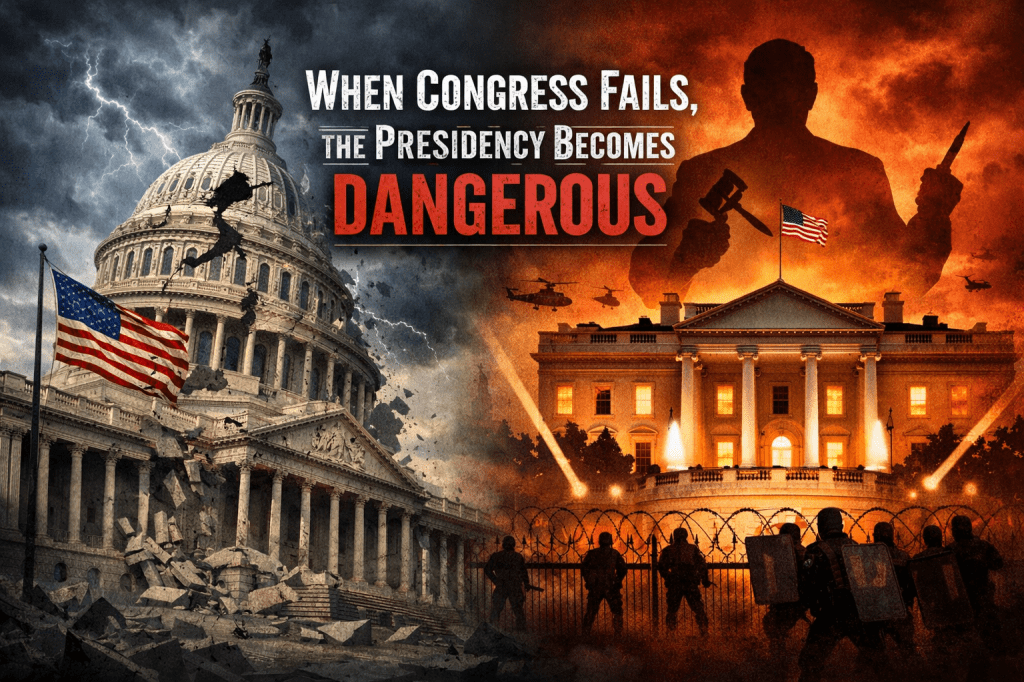
The Trump administration revealed not only the dangers of executive overreach, but the consequences of congressional failure. The Constitution assumes that ambition will counter ambition; when Congress refuses to act, that safeguard collapses.
Unchecked executive power—whether exercised recklessly or strategically—poses a long-term threat to democratic stability. Restoring constitutional balance requires Congress to reclaim its Article I authority, enforce ethical standards, and reassert its role in matters of war, oversight, and accountability. Without such reform, future administrations will inherit a system in which restraint depends not on law, but on personal discretion.
The question is no longer whether the system has weaknesses. Those weaknesses have been exposed. The question now is whether they will be addressed before the next crisis makes the cost unavoidable.
References
Authorization for Use of Military Force, Pub. L. No. 107-40, 115 Stat. 224 (2001).
https://www.congress.gov/107/plaws/publ40/PLAW-107publ40.pdf
Congressional Research Service. (2022). Presidential war powers: Modern practice and legal authority.
https://crsreports.congress.gov
Citizens for Responsibility and Ethics in Washington v. Trump, 953 F.3d 178 (2d Cir. 2020).
https://casetext.com/case/citizens-for-responsibility-ethics-in-washington-v-trump
District of Columbia v. Trump, 930 F.3d 209 (4th Cir. 2019).
https://casetext.com/case/district-of-columbia-v-trump
H.R. Res. 755, 116th Cong. (2019).
https://www.congress.gov/bill/116th-congress/house-resolution/755
ProPublica. (2020). Tracking Trump’s conflicts of interest.
https://www.propublica.org
U.S. Constitution.
https://constitution.congress.gov
War Powers Resolution, 50 U.S.C. §§ 1541–1548 (1973).
https://www.law.cornell.edu/uscode/text/50/chapter-33
 Greg MD Blog
Leave a comment