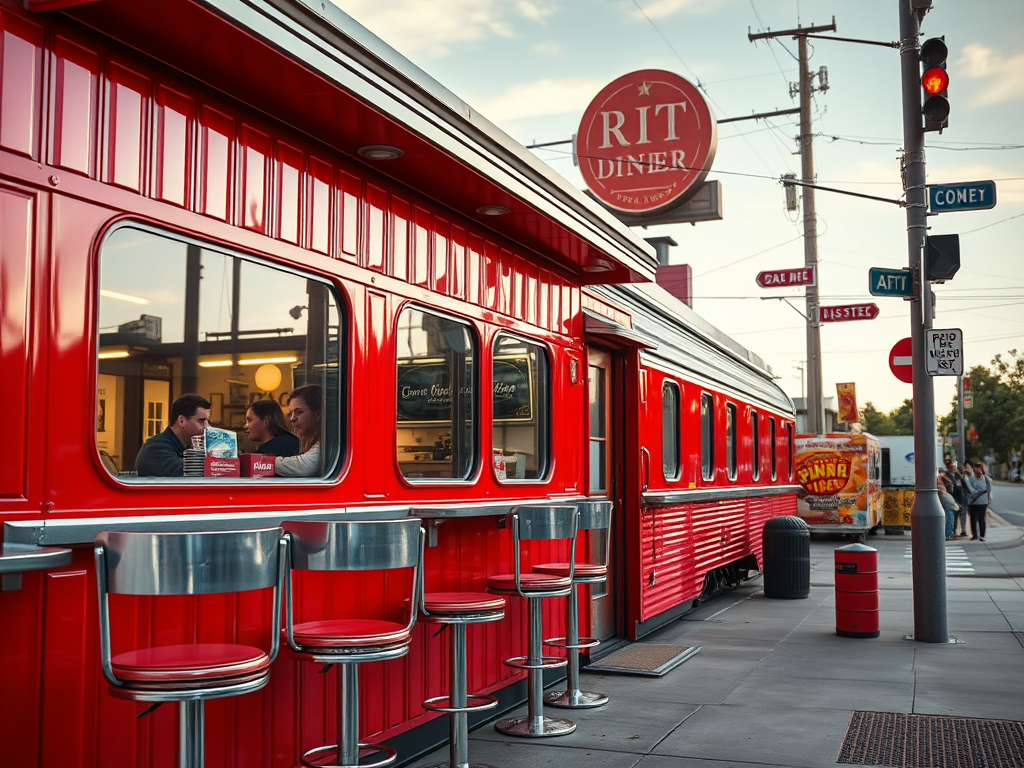
From Field’s to Theo’s: The Red Train-Car Diner — A Dallas Story
By Gregory McDowell-Dresden (formerly known as Alan Ray)
Before Dallas gleamed with glass towers and modern brunch spots, there was a stretch of Hall Street where the scent of bacon, coffee, and biscuits filled the morning air. On the corner of 111 N. Hall Street and Main—between Main and Commerce Streets—sat a narrow red train-car diner that looked like it had rolled right off the tracks and settled there to stay. It was called Theo’s Diner—a little capsule of warmth, hard work, and everyday life in the middle of a city still finding its rhythm.
From 1984 to 1986, I was known as Alan Ray, one of three people who kept that small diner alive. Gayle Ross worked the counter, Demetri ruled the grill, and I moved between them, passing plates, calling orders, and greeting regulars who had their coffee the same way every morning. The place was no bigger than a trailer, but it was alive with energy—the hiss of the griddle, the clatter of plates, and the hum of voices that filled the space like music.
The diner’s counter curved along one side of the narrow room, lined with chrome stools that squeaked when you spun them. The walls were paneled in shiny red metal, worn smooth from years of elbows resting there. There was no separation between the staff and the customers—just a thin strip of counter and a shared sense of belonging. People came not only to eat but to talk, to laugh, and to start their day among familiar faces.
Originally, Theo’s wasn’t just a breakfast stop. Every late morning, after the rush died down, food-truck operators from around Dallas would pull up to the curb outside our little red diner. They came to buy hamburgers and cheeseburgers by the dozen—wrapped in wax paper, stacked in cardboard boxes, and ready for the road. Those trucks would head out to construction sites across the city, feeding the workers who were literally building Dallas’s skyline one steel beam at a time. We were the quiet link between the heartbeat of the city and the people shaping it.
The neighborhood around Hall and Main was rough-edged but full of life. Two blocks in any direction, you could hear 1960’s, Tejano, and blues music blending with the sound of machinery and passing trucks. Across the street stood a machine shop; next door, a parts warehouse. By noon, the sound of hammering mixed with the rumble of traffic and the steady clink of silverware against porcelain inside our diner. The rhythm of the street became the rhythm of our lives.
Demetri treated the grill like a trusted friend. He worked fast, laughing as he cooked, a towel slung over his shoulder. Gayle ran the counter with ease—she could remember every customer’s usual before they even sat down. I found my rhythm between them, balancing tickets, refills, and conversation, learning the pace of life in that little red car. We weren’t just coworkers; we were a family holding together a tiny corner of the city.
When Theo’s finally closed in the late 1980s, it felt like losing a piece of Dallas itself. But a few blocks north, on Hall Street, another diner opened that carried the same heartbeat—Theo’s Diner, owned and operated by Greek-American cook **Theo Kostas**. Theo’s became the next chapter of our story, and in many ways, it kept the spirit of the red train-car diner alive.
Theo’s had more space and newer walls, but the feeling was the same. The counter wrapped around the grill, and regulars came not just to eat, but to belong. The air smelled of pancakes, bacon, and fresh coffee; the same laughter that once filled Field’s now drifted through Theo’s. Theo himself had that rare ability to make every guest feel known, greeting people with a grin and a story while flipping eggs behind the counter. He carried forward the same blue-collar heart that Field’s had embodied, serving cab drivers, nurses, and construction workers with equal warmth.
Through the 1990s and 2000s, Theo’s Diner became a fixture in Oak Lawn and Uptown—a living link to the older Dallas that refused to disappear. It was the kind of place where you could still hear the scrape of a fork, the hiss of the griddle, and the low murmur of familiar voices trading jokes before sunrise.
By 2019, the march of redevelopment reached Hall Street. Theo’s closed quietly, its sign coming down one morning as new construction began to rise. The corner changed, but for those who remembered, the ghost of that old red train car still lingers. Every time I drive through that part of Dallas, I can still see it: the glow of the neon, the smell of coffee, and the hum of life in a place that felt like home.
Dallas has changed, but its diners—Field’s and Theo’s—will always be part of its soul. They fed the workers, the dreamers, and the early risers who built the city. And for me, those years behind the counter gave something more enduring than a paycheck: a sense of belonging, and a reminder that the truest measure of a place isn’t in how long it stands, but in the people who remember it.
[Photo Caption Placeholder: Field’s Diner and Theo’s Diner, Hall Street, Dallas — 1980s–2000s]
https://www.dmagazine.com/publications/d-magazine/1986/january/best-worst/
“GRILLED CHEESE
Best: Theo’s Diner, 111 S. Hall St. The ultimate grilled cheese thrill, accompanied by peerless fries and plot summaries of “All My Children” by the proprietress.”
https://directory.dmagazine.com/restaurants/theos-diner/
“At this funky, Greek-inspired “cheeseburger, cheeseburger” joint in Deep Ellum, cheeseburgers are thin and covered with melted American, the fries are hand-cut, and the grilled cheese on Texas toast is cooked in garlic butter.”
 Greg MD Blog
Leave a comment